Roosmarijn Pallandt The Netherlands, b. 1977
Biography
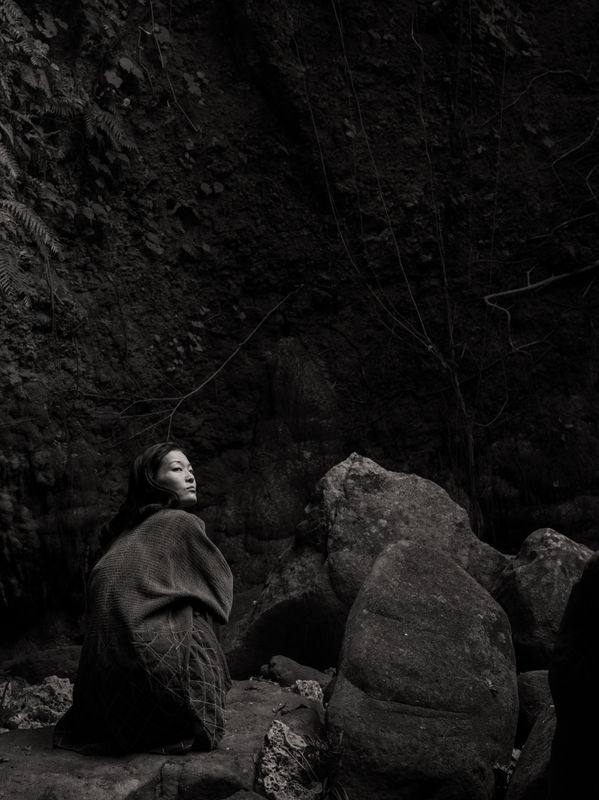
delicate platinum prints made on the thinnest possible handmade Gampi paper, light enough for a single breath to lift the surface, often depicting ritual sites charged with cultural and symbolic meaning, and sound works derived from direct elemental interaction.
Roosmarijn Pallandt is known for her interdisciplinary installations that integrate analog film & photography, sound, and textile to explore the body as a perceptual and physical instrument. With a background in dance, her practice is grounded in embodied and somatic knowledge, positioning breath, movement, and rhythm as both material and methodological frameworks. Breath, in particular, functions as both material and method: a means to navigate altered states, guide movement, and attune to place. Her process, rooted in extended presence, often pushes the limits of her physical body. Working in remote environments such as the Tibetan Plateau, the Islands of Yeayama, Oceania, and the deserts of Peru and Iran, Pallandt develops her work through deep engagement with local people and cultures.
Across media, she employs slow, tactile, analog processes: textiles woven from tree bark and plant fibres calibrated to breath and rhythm as articulated through ritual vocals and prayers; delicate platinum prints made on the thinnest possible handmade Gampi paper, light enough for a single breath to lift the surface, often depicting ritual sites charged with cultural and symbolic meaning, and sound works derived from direct elemental interaction. Ritual plays a central role in her work not as spectacle, but as embodied attention, a way of focusing through rhythm, material, and spatial awareness. Across all media, Pallandt asks how far the body can stretch, physically and perceptually, to listen, remember, and connect. Rather than reconstructing lost systems, her work reactivates the body as a listening instrument, attuned to the multiple registers of the planet.
Pallandt is currently teaching, living, and developing new work in remote parts of New Zealand, while also spending time in Nepal and Japan. Her work has been exhibited internationally at institutions and festivals including the Museo de Arte de Zapopan, Jalisco, Mexico; Kunming Contemporary Gallery, Yunnan, China; Lumen Festival, London; Desert Festival, Alice Springs, Australia; and Kyotographie, Kyoto, Japan. She presented a sound piece in Glasgow at COP26, where she recorded the sound of photosynthesis. Notable artist residencies include Casa Wabi Artist Residency and Rabbit Island Artist Residency.
Works
-
 Mari, 2021
